

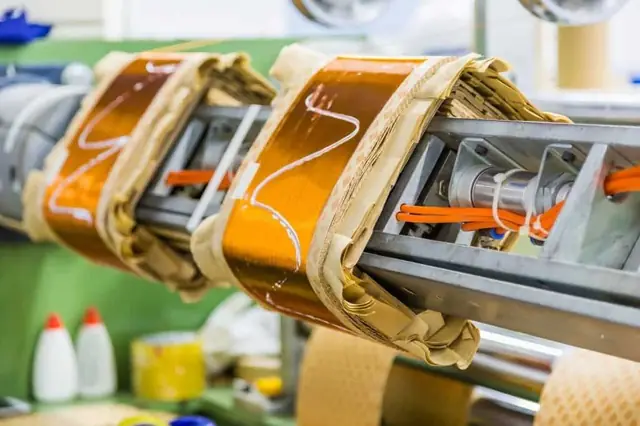
Bimetallic strip (thermal protection)
The safety device that protects the transformer against overheating.
Definition
The bimetallic strip is a thermal protection device made of two metal strips with different expansion coefficients, bonded together. Under the effect of heat, the difference in expansion causes a mechanical deformation that opens or closes an electrical contact — cutting the supply or triggering an alarm.
In transformers, the bimetallic strip is positioned in contact with the windings or the core, where the temperature is highest. It operates when the temperature exceeds the threshold of its thermal insulation class (class B: 130 °C, class F: 155 °C, class H: 180 °C). Without this protection, an overloaded transformer or one with failed ventilation could see its insulation degrade irreversibly.
Bimetallic strips are generally self-resetting (the contact closes again once the temperature has dropped) or manual (requiring physical intervention). For critical applications, they are combined with other sensors: PT100 probes, PTC thermistors or electronic thermostats.
The ABL tip
ABL Transfo systematically integrates thermal protection on power transformers and on transformers intended for harsh environments (high load, poor ventilation, closed cabinets). For medical or safety applications, we can provide redundant thermal monitoring.